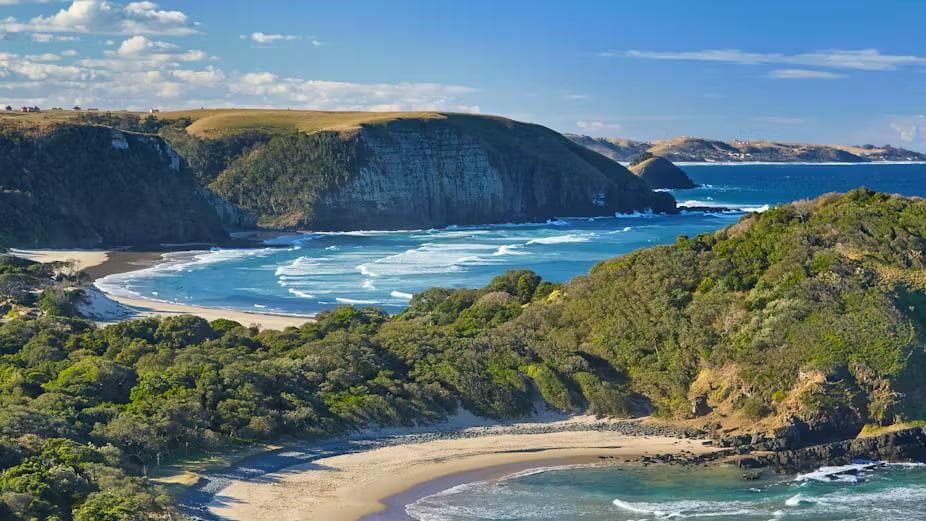
Africa has an enormous ocean area at its disposal. There are almost 20 million square kilometres of ocean, seas and inland water that could be developed into environmentally sustainable blue economies. The G20 group of 19 of the world’s largest economies and the African Union also view the blue economy as key to developing the continent. Nomtha Hadi researches blue economies. She talks to The Conversation Africa about the main challenges in developing blue economies in Africa.
The blue economy refers to using water and ocean resources to create economic growth, improved livelihoods, and jobs – and doing this in a way that is sustainable.
A blue economy therefore needs to be based on a sustainable balance between often competing ecological and economic goals. It must be effectively managed so that it does not damage the marine environment. This will allow the blue economy to grow and benefit future generations.
Aquaculture in Madagascar. Alexis Rosenfeld/Getty Images
There is much potential. Africa includes the island states of Mauritius, Comoros, Seychelles and Madagascar. Thirty eight (38) of the fifty four (54) African countries are coastal states. The continent also already has new and developing blue economy industries. These include:
Already, freshwater and marine fish contribute to the food security of over 200 million people in Africa. The continent’s fishing industry is vast. It includes inland and marine fisheries, processing facilities, licensing of local fleets of boats, and aquaculture. It provides employment for over 12 million people on the continent.
Its value has been estimated at more than US$24 billion annually. By 2021, this represented 1.26% of the total gross domestic product (GDP) and 6% of the agricultural GDP of all African countries.
The African Union has developed a 2050 Africa Integrated Maritime Strategy. This is a plan for how the blue economy could speed up economic transformation and sustainable development in Africa. It also sets out how Africa’s maritime domain could be exploited without damaging the marine environment.
Its overarching vision is to foster increased wealth creation from Africa’s oceans, seas and inland waters.
The ocean provides food for many people. Coastal communities often provide jobs, energy and raw materials. This enables global trade as well as recreational and cultural services. Yet, developing and growing the ocean economy is becoming a serious challenge.
Marine resources are vital for meeting global needs like food, energy, jobs, medicine and transport. But as people and corporations use the ocean more, they also put greater pressure on its ecosystems.
Across the world and in Africa, the ocean is under pressure from pollution and climate change. Rising temperatures, sea levels, acidification, and loss of marine life are major concerns.
In Africa, key threats to the blue economy include pollution (mostly from land), illegal and unregulated fishing, climate change, and disease outbreaks. For example, overfishing reduces fish stocks, making ocean industries less sustainable and weakening the foundation of the blue economy.
Before taking on the G20 presidency, the South African government came up with policies to preserve life under water. These include marine protection and governance services that are part of Operation Phakisa. This is a national plan for economic development in the water and oceans of South Africa.
The South African G20 presidency has brought some of this knowledge into the G20. The G20 already had an ocean focus – the Ocean 20 initiative started by Brazil, the G20 president in 2024. The Ocean 20 aims to achieve better collaboration across government, research, business and civil society. It has a strong focus on including communities in the blue economy, using new innovations and making sure that economic development in water and oceans is sustainable.
South Africa’s G20 presidency now has to turn Ocean 20 into a reality. These are some steps it needs to take to promote a well developed blue economy for South Africa and other G20 countries:
A blue economy can’t be built by one government or group alone, or by focusing on just one industry. It needs cooperation between governments, global organisations, businesses, universities, non-governmental organisations and individuals, all working together to protect and use the ocean sustainably.